
- There are no more items in your cart
- Shipping
- Total £0.00

Power stations and utility sites require earpieces that deliver clear audio in high-noise environments, withstand demanding physical conditions, and — in hazardous zones — meet ATEX certification standards. Under the Dangerous Substances and Explosive Atmospheres Regulations 2002 (DSEAR), ATEX-compliant radios and accessories are a legal requirement in any area classified as a potentially explosive atmosphere. This guide covers what to look for, which regulations apply, and the best earpiece options available at EarpieceOnline.co.uk.
Communication failures at power stations and utility sites are not just an inconvenience — they are a safety risk. Whether you manage a control room, co-ordinate maintenance teams across a live facility, or run a site security operation, reliable, clear voice communication is essential at every level.
The challenge is that these environments push standard communication equipment to its limits. Machinery noise, temperature extremes, chemical exposure, and — most critically — the presence of flammable gases or combustible dust in certain zones all place strict demands on the equipment your teams use. Choosing the wrong earpiece does not just affect audio quality. In high-risk zones, it could breach your legal obligations under UK health and safety law.
This guide covers everything you need to know about selecting the right radio earpieces for power stations and utility sites, including which regulatory standards apply, what features matter most, and specific product recommendations to suit different roles across your site.
What Does ATEX Certification Mean for Power Station Communication Equipment?
ATEX stands for Atmosphères Explosibles — the EU and UK regulatory framework that governs equipment designed for use in potentially explosive atmospheres. An ATEX-certified radio or earpiece is classified as intrinsically safe, meaning it has been independently engineered and tested to confirm it cannot release sufficient electrical or thermal energy to ignite a surrounding explosive atmosphere, even under fault conditions or physical damage.
This matters enormously in power stations, because not all areas of a facility carry the same risk profile. A control room environment differs significantly from a hydrogen storage area, a fuel terminal, or a cable basement where combustible dust may accumulate. UK law — specifically the Dangerous Substances and Explosive Atmospheres Regulations 2002 (DSEAR) — requires employers to classify work areas into hazardous zones and ensure that all electrical equipment used within those zones, including two-way radios and their accessories, meets the appropriate ATEX standard.
Using a standard, non-ATEX radio or earpiece in a classified hazardous zone is not just a risk management issue. It is a statutory breach that can result in enforcement action, prosecution, and — in the worst case — a preventable fatality.
Which Areas of a Power Station or Utility Site Require ATEX Equipment?
ATEX requirements apply wherever your site has been classified as a potentially explosive atmosphere. According to DSEAR, these zones are categorised as follows:
- Zone 0 / Zone 20 — Areas where explosive gas or dust is present continuously or for long periods
- Zone 1 / Zone 21 — Areas where explosive atmospheres are likely to occur during normal operation
- Zone 2 / Zone 22 — Areas where explosive atmospheres are not likely under normal conditions, but may occur occasionally
In power generation and utility infrastructure specifically, ATEX-certified equipment is typically required in areas including hydrogen production and storage, gas-insulated switchgear rooms, fuel terminals, cable vaults, and sections of pipeline infrastructure.
Outside of classified zones — in general control rooms, security gatehouse operations, or administrative areas of the site — standard high-quality radio earpieces may be used, provided they meet the performance and durability requirements of an industrial environment.
What Are the Key Features to Look for in a Utility Site Radio Earpiece?
Regardless of whether your site requires ATEX compliance, all earpieces used in power station and utility environments should meet a minimum standard of robustness and performance. Here is what to prioritise.
How Important Is Noise Cancellation in Industrial Environments?
Noise cancellation is arguably the most critical feature for utility site earpieces. Industrial facilities regularly expose workers to ambient noise levels exceeding 85 dB — the threshold above which the Health and Safety Executive (HSE) requires noise risk assessment under the Control of Noise at Work Regulations 2005. In turbine halls, switchgear rooms, and substations, those levels can be significantly higher.
An earpiece with a noise-reducing microphone filters out background noise at the point of transmission, ensuring that outgoing messages are intelligible. Equally, the audio driver in the earpiece itself should deliver clear, loud enough sound that incoming messages can be heard over ambient noise without the user removing their hearing protection.
Why Does Earpiece Durability Matter in Demanding Conditions?
Power station environments expose equipment to heat, vibration, moisture, and — in some areas — chemical exposure. Earpiece cables need to withstand repeated bending, tension, and industrial wear without degrading. Kevlar-reinforced cabling is a significant practical advantage in these settings, extending the working life of the earpiece considerably compared to standard cable construction.
For security teams working outdoors across utility sites, weather resistance is an additional consideration, as is the physical robustness of connection points and PTT (push-to-talk) buttons.
Which Two-Way Radio Brands Are Commonly Used at Power Stations?
Most UK power stations and utility operators use professional-grade two-way radio systems from manufacturers including Motorola, Hytera, Icom, Kenwood, and Entel. Your earpiece must be compatible with the specific radio model and connector type used across your site. EarpieceOnline.co.uk stocks earpieces compatible with all of these major brands, and selecting the correct model for your radio type is straightforward using their product filters.
Recommended Earpieces for Power Stations and Utility Sites
The following earpieces are available at EarpieceOnline.co.uk and are well-suited to the varying communication roles found across power station and utility operations.
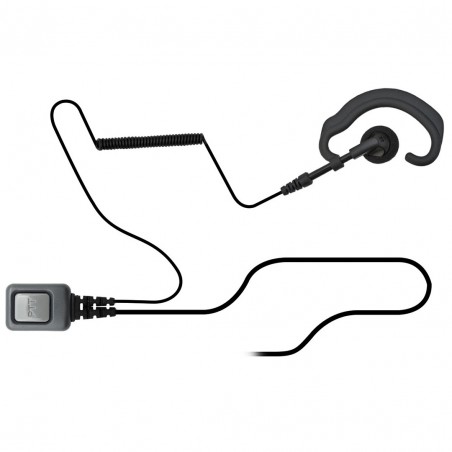
G-Shaped Overt Earpiece — Best for Control Room Operators and Security Personnel
Price: £15.50
The G-Shaped Overt Earpiece sits comfortably outside the ear canal, making it a practical option for staff who wear the device throughout long control room shifts or extended security patrols. Its design bridges the gap between a standard acoustic tube and a D-ring earpiece, offering a secure fit without the occlusion of a full in-ear solution.
Key features include:
- Comfortable, secure fit that rests gently outside the ear canal
- High-quality audio output for clear communication
- In-line lapel clip with push-to-talk (PTT) and microphone functionality
This earpiece is a reliable day-to-day solution for control room operators who require clear, consistent communication with field teams, and for security personnel conducting site access control and perimeter monitoring.
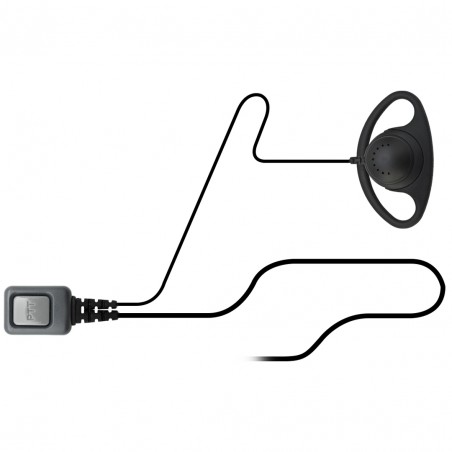
D-Ring Covert Earpiece — Best for Site Security Teams
Price: £14.95
The D-Ring Covert Earpiece is designed for professional, discreet communication — a priority for utility site security teams who need to maintain situational awareness without signalling their communication activity. It features a clear acoustic tube that routes sound from the radio to a mushroom eartip seated in the ear canal.
Key features include:
- Discreet acoustic tube with mushroom eartip for in-ear audio delivery
- Kevlar-reinforced cabling — a significant durability advantage for active field use
- Compatible with major two-way radio brands across Motorola, Hytera, Icom, and Kenwood
The Kevlar-reinforced cable makes this earpiece a particularly strong choice for security teams who need equipment that holds up under daily active use, outdoor conditions, and repeated connection cycles.
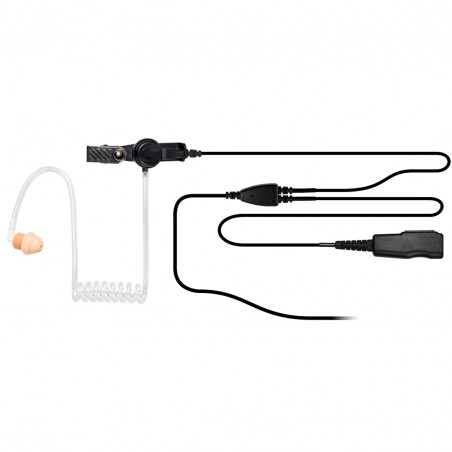
Covert Acoustic Tube Earpiece (Motorola 2-Pin) — Best for Maintenance Technicians in Non-Hazardous Zones
The Covert Acoustic Tube Earpiece is designed for Motorola 2-pin radio connections and offers a step up in audio performance for environments where background noise is a significant factor.
Key features include:
- High-quality audio delivery — crisp and clear sound even in loud environments
- Noise-reducing microphone that filters background noise for intelligible outgoing transmission
- Acoustic tube design for reliable, hands-free operation
This earpiece is well-suited to maintenance technicians operating in non-ATEX-classified zones of a power station who need to maintain communication while working with both hands. For technicians whose roles take them into classified hazardous zones, the radio and all connected accessories — including earpieces — must be ATEX-rated.
Browse the full radio earpiece range at EarpieceOnline.co.uk: https://www.earpieceonline.co.uk/198-radio-earpiece
Why ATEX Radios Are Non-Negotiable in High-Risk Zones
It is worth being explicit about this distinction, because it is one that site managers sometimes underestimate. The earpieces recommended above are high-quality professional communication accessories. However, in any area of your site classified as a hazardous zone under DSEAR, the radio itself must be ATEX-certified — and, where applicable, so must the accessories connected to it.
A standard two-way radio — even a robust, professional-grade one — generates small amounts of electrical energy during normal operation. In a non-hazardous environment, this presents no risk. In a zone containing flammable gases, explosive vapours, or combustible dust, that same electrical activity could, under the right conditions, provide an ignition source.
ATEX-certified radios are intrinsically safe by design. Every component — from battery chemistry and casing materials to antenna design and speaker housing — is engineered and independently certified to eliminate ignition risk. Models from Hytera, Motorola, and Icom offer ATEX-rated variants of their professional radio lines, and these should be the starting point for any hazardous zone communication plan.
Key ATEX radio features relevant to power station and utility environments include:
- Intrinsic safety certification — verified by an approved third-party body, denoted by the Ex symbol
- IP67 dust and water resistance — critical for industrial operating conditions
- Man-down and lone worker alerts — automatically triggered if a worker becomes motionless or incapacitated
- One-touch emergency broadcast to a control room or supervisor
- Integrated GPS tracking for real-time worker location monitoring
- Noise-cancelling audio for clear communication in high-ambient-noise environments
Where ATEX accessories (headsets, speaker-microphones) are required, they are typically colour-coded blue — the universal industry standard for intrinsically safe equipment.
Implementation Best Practices for Radio Earpieces at Power Stations
Selecting the right earpiece is the first step. Getting the most from your communication equipment across a large facility requires a considered approach to deployment, training, and maintenance.
How Should Staff Be Trained on Earpiece Use in Industrial Environments?
Training should cover correct fitting, daily inspection before use, PTT discipline in high-noise areas, and hygiene protocols for shared earpieces. In hazardous zones, training must also address the importance of not substituting non-ATEX accessories — including earpieces — on ATEX-rated radios, as doing so can compromise the intrinsic safety rating of the radio system.
How Often Should Earpieces Be Inspected and Replaced?
Industrial earpieces should be visually inspected before each shift for cable damage, connector integrity, and eartip condition. A structured replacement schedule — typically every six to twelve months under heavy daily use — prevents degraded audio quality and communication reliability from becoming a safety issue. Kevlar-reinforced earpieces, such as the D-Ring Covert option, generally offer a longer service life than standard-cable alternatives.
How Can Earpieces Be Integrated Into an Existing Site Radio System?
The key compatibility factor is the radio connector type. EarpieceOnline.co.uk offers earpieces across all major connector types used by Motorola, Hytera, Icom, Kenwood, and Entel radios. If your site operates a mixed fleet of radio brands — not uncommon in large utility organisations that have consolidated systems over time — universal earpiece options and adaptor kits are available.
Protecting Workers Through the Right Communication Equipment
Earpieces at a power station or utility site are not simply a convenience item. They are part of the safety infrastructure. Clear, reliable communication enables faster incident response, better coordination between control room and field teams, and — when paired with ATEX-certified radio systems — protection from ignition risk in classified hazardous zones.
Investing in the right equipment from the outset is substantially less costly than the alternative: equipment failure during a critical operation, a regulatory breach under DSEAR, or a preventable incident in a hazardous zone.
For non-hazardous areas of your facility, the earpieces available at EarpieceOnline.co.uk offer a range of professional-grade options to suit control room operators, maintenance technicians, and security teams alike. For classified hazardous zones, ATEX-rated radios and accessories are the legal and ethical baseline — and that requirement should be built into every procurement decision your site makes.
Browse radio earpieces for utility and industrial use at EarpieceOnline.co.uk
Frequently Asked Questions
Are ATEX earpieces legally required at power stations?
ATEX-certified communication equipment — including both the radio and its accessories — is a legal requirement under the Dangerous Substances and Explosive Atmospheres Regulations 2002 (DSEAR) in any area of a power station or utility site classified as a hazardous zone. Non-ATEX equipment used in classified zones constitutes a statutory breach, regardless of its quality or durability.
What is the difference between ATEX-rated and standard radio earpieces?
Standard radio earpieces are designed for general professional use. ATEX-rated earpieces have been independently certified to confirm they cannot release sufficient electrical or thermal energy to ignite a surrounding explosive atmosphere. In non-hazardous areas of a power station — such as general control rooms or security gatehouses — standard professional earpieces are appropriate and cost-effective.
Which earpiece style is best for control room operators at utility sites?
Control room operators typically benefit most from the G-Shaped Overt Earpiece, which rests comfortably outside the ear canal for extended wear during long shifts. Its in-line PTT and microphone functionality allows for hands-free communication with field teams without the fatigue associated with fully in-ear designs.
Do power station maintenance teams need ATEX earpieces?
Maintenance technicians working in non-classified areas of a power station can use standard professional earpieces such as the Covert Acoustic Tube Earpiece with noise-reducing microphone. Any maintenance team member entering a classified hazardous zone must use a fully ATEX-certified radio system, including ATEX-rated accessories.
What does ATEX stand for, and which UK regulation enforces it?
ATEX stands for Atmosphères Explosibles, derived from the French term for explosive atmospheres. In the UK, the use of ATEX-certified equipment in hazardous zones is enforced under the Dangerous Substances and Explosive Atmospheres Regulations 2002 (DSEAR), which requires employers to classify their workplaces and ensure all electrical equipment meets the appropriate intrinsic safety standard.
How do I know which earpiece is compatible with my site's radio system?
Compatibility depends on the connector type used by your specific radio model. EarpieceOnline.co.uk stocks earpieces compatible with all major professional radio brands — including Motorola, Hytera, Icom, Kenwood, and Entel — and product listings specify which connector types are supported. If your site runs a mixed radio fleet, universal connector options and adaptor kits are also available.
(3) (0)
 Whatsapp
Related Products
-
G -shaped Overt Earpiece
G-shaped earpieces (which form a ‘G’ shape as opposed to the ‘D-ring’ desig...
-
D-Ring Covert Earpiece
Our Top quality, flexible rubber D fits comfortably over the ear. The PTT a...
-
Covert Acoustic Tube Earpiece
Enhance your covert communications with our 2-wire kits, featuring a combin...