- There are no more items in your cart
- Shipping
- Total £0.00
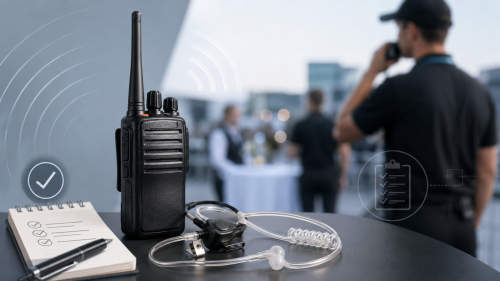
The best radio communication practices follow four key principles—clarity, brevity, simplicity, and security. Plan your message before pressing the button, speak slowly and clearly, use standard terms like "over" and "roger", and keep transmissions under 30 seconds. The right earpiece also makes a big difference to how well you're heard.
Good radio communication can be the difference between a smooth operation and total confusion. Whether you're coordinating security teams, running a construction site, or managing a busy event, getting your message across quickly and clearly matters.
The problem? Radios don't forgive sloppy habits. Talk too fast, mumble, or interrupt someone mid-sentence, and your message gets lost. The good news is that strong radio communication comes down to a handful of simple, learnable rules.
This guide breaks down the proven best practices used by professional teams, explains the most common radio terms, and shows you how the right accessories can sharpen every transmission.
What are the four core principles of radio communication?
Professional radio users tend to follow four guiding principles, sometimes called the four Cs:
- Clarity: Speak so every word can be understood. Hold the microphone a few inches from your mouth and pronounce each word fully.
- Brevity: Keep it short. According to Weavix, transmissions should ideally last 30 seconds or less to avoid clogging the channel.
- Simplicity: Use plain, direct language. Save the jargon and stick to terms everyone on the channel understands.
- Security: Never share sensitive details over an open channel. Assume others can hear you.
Master these four, and you've already solved most common radio problems.
How should you speak on a two-way radio?
Hytera, a leading radio manufacturer, recommends a simple sequence: prepare before you speak, talk clearly and slowly, keep it short, and confirm you've been understood. Here's how to put that into practice.
Plan your message before you press the button
Decide what you want to say and who it's for before you transmit. A quick mental rehearsal stops you from rambling or "umming" on an open channel. If your message is long, break it into short chunks and pause between each.
Speak slowly and clearly
Press the push-to-talk (PTT) button, wait a second, then speak. If you talk the instant you press the button, the first word often gets cut off. Keep your voice steady and at a normal pitch—shouting actually distorts the audio.
Wait your turn
Only one person can transmit at a time. Interrupting someone mid-message means both transmissions get garbled. Listen before you speak, and let each person finish.
Confirm understanding
Don't assume your message landed. Ask for confirmation, or repeat back key details. For tricky words, names, or codes, use the NATO phonetic alphabet (Alpha, Bravo, Charlie, and so on). Created in 1956, this alphabet was designed to help forces communicate clearly in noisy or high-pressure situations—and it works just as well on a building site.
What do common radio terms like "over" and "roger" mean?
Standard radio terms keep conversations short and prevent confusion. Here are the essentials:
- Over: I've finished speaking and expect a reply.
- Out: The conversation is complete; no reply needed. (Note: you never say "over and out"—they mean opposite things.)
- Roger: Message received and understood. The term dates back to Morse code days, when "R" stood for "received".
- Copy: I heard and understood your message.
- Say again: Please repeat your last message. (Use this instead of "repeat", which has a specific meaning in some settings.)
- Affirmative / Negative: Yes / no.
- Standby: Wait a moment.
Sticking to these terms means your team spends less time clarifying and more time getting things done.
Why does the right earpiece improve radio communication?
Even flawless radio technique falls apart if you can't hear or be heard. In loud environments—construction sites, busy venues, crowded streets—a built-in radio speaker simply won't cut it. A quality earpiece keeps audio private, clear, and close to your ear.
EarpieceOnline offers a range of earpieces suited to different working conditions. Here's how to match the accessory to the job:
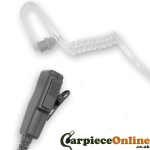
- Covert acoustic tube earpiece (from £20): Ideal for security and surveillance work where discretion matters. The clear tube and combined PTT/microphone keep communications private, with Kevlar-reinforced cabling for durability.
- D-Ring covert earpiece (£12): A flexible rubber D that sits comfortably over the ear, working with all Motorola 2-pin connectors. A solid budget choice for everyday use.
- G-shaped overt earpiece (£12): The G-shape is generally more comfortable than the traditional D-ring design, making it a good pick for long shifts.
- Two-way radio headset (£90): Over-the-head ear cups cut out noise in very loud settings like construction sites. Features a boom mic, volume control, and PTT button.
- Bone conductor earpiece (£40): Transmits clear speech while leaving your ear canal open, so you can still hear your surroundings—perfect for the loudest environments.
- ResoWire earpiece (£35): The latest covert tube technology, offering superior sound, a discreet design, and fewer blockages than standard acoustic tubes.
Choose a covert earpiece if discretion is your priority. Pick a headset or bone conductor if noise reduction matters more than being low-profile.
How do you keep your radio kit working reliably?
A few simple habits keep your equipment dependable:
- Test before every shift. A quick radio check confirms both your radio and earpiece are working.
- Keep batteries charged. Carry a spare battery for long shifts.
- Replace worn parts. Acoustic tubes and ear moulds wear out—swapping them keeps audio crisp. EarpieceOnline stocks replacement tubes, ear plugs, and in-ear moulds.
- Match the connector to your radio. Earpieces are model-specific, so check whether your radio uses a Motorola, Kenwood, Icom, Hytera, or other connector before you buy.
Putting it all together
Strong radio communication isn't complicated—it's disciplined. Plan your message, speak clearly and slowly, keep it brief, use standard terms, and wait your turn. Layer on the right earpiece for your environment, and your whole team will communicate faster and with fewer mistakes.
Ready to upgrade your kit? Browse the full range of radio earpieces at EarpieceOnline and find the right fit for your radio model and working conditions.
Frequently asked questions
What is the most important rule of radio communication?
Clarity is the most important rule. If your message can't be understood, nothing else matters. Speak slowly, pronounce each word fully, and hold the microphone a few inches from your mouth.
Why shouldn't you say "over and out"?
"Over" means you expect a reply, while "out" means the conversation is finished. Saying both together is contradictory, so professional radio users only ever use one or the other.
How long should a radio transmission be?
Keep transmissions to 30 seconds or less. Long messages clog the channel and stop others from getting through. If you need to say more, break it into shorter chunks with pauses in between.
What earpiece is best for noisy environments?
For very loud settings like construction sites, a two-way radio headset (£95) or a bone conductor earpiece (£38.29) works best. Both are designed to deliver clear audio while reducing background noise.
How do I know which earpiece fits my radio?
Earpieces connect via model-specific connectors. Check whether your radio uses a Motorola, Kenwood, Icom, Hytera, or other connector type, then choose an earpiece that matches. EarpieceOnline lets you select your connector at checkout.
(217) (0)
 Whatsapp